
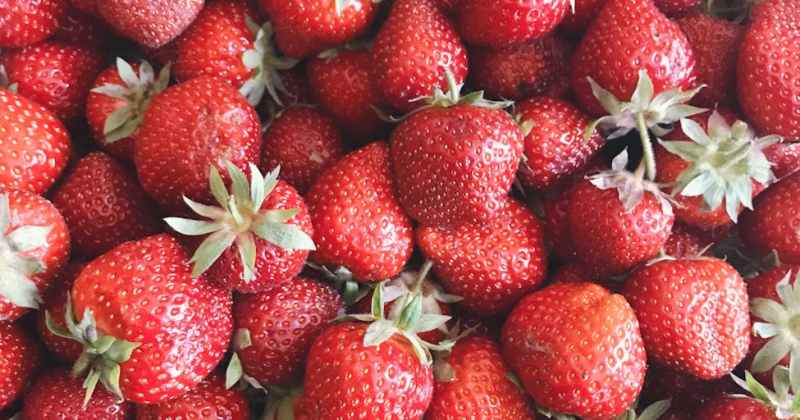

Strawberry plants are low-growing perennials but also so much more. They’re one of the best fruits of summer, the only fruit with seeds on the outside, and a great go-to for DNA experiments. There are 103 species of strawberries, but the ones featured in your favorite summertime dessert or currently turning red in your garden likely trace their lineage back to a cross between a North American species, Fragaria virginiana, and a Chilean species, Fragaria chiloensis which happened in France around 1750. Because these plants are a hybrid their Latin name is Fragaria x ananassa. Here are six more things you might not know (but will want to know) about strawberries:
They aren’t berries.
Berries are simple, fleshy fruits that have many seeds and are derived from a single ovary of an individual flower. However, strawberries are derived from the outer casing that holds the ovaries. Still, the strategy of the strawberry and most other berries is the same: spread progeny by getting animals to eat, digest, and eventually disperse the fruit and seeds. And in a world of avocados, tomatoes, bananas, etc., strawberries are not alone in not fitting perfectly into a botanical box.
Speaking of seeds…
On average, a strawberry has about 200 seeds on its external membrane.
People like strawberries,
The world production of strawberries in 2021 was ~9.2 million tons. That’s because they pack a health punch and taste great. A typical strawberry is 91% water, 8% carbohydrates, and 1% protein. They are also a rich source of vitamin C, nitrate, and manganese. For more healthy reasons to load up on strawberries, check out this article “Top 10 Health Benefits of Strawberries.” An un-cited, but believable, survey found that 53 percent of seven to nine year olds said strawberries were their favorite fruit.
Unless the person is allergic.
Strawberry allergies are less common than other dietary allergies but do exist. Between 2 and 4% of children under 2 are allergic. In the over 2 crowd, this percentage drops to between 0.5 and 1%. Proteomic studies have indicated that the allergy may be tied to a protein named Fra a1 (Fragaria allergen 1) involved in red anthocyanin biosynthesis that occurs during ripening. Luckily, strawberries come in various colors including yellow, blue, purple, white, and black. White, yellow, and golden strawberries are becoming popular because they do not contain Fra a1 and because their appearance makes them less attractive to birds.
Strawberries are excellent for DNA extraction.
When it comes to extracting the blueprint of life, strawberries can yield more DNA than just about any other fruit out there. One reason is that strawberries are soft and easy to pulverize. Another reason is that strawberries have huge genomes. Like many plants, strawberries are polyploids—organisms that contain more than two homologous sets of chromosomes. Strawberries are octoploids – that means eight complete sets of chromosomes. Read this great Nature article to learn more about the strawberry genome.
Also check out our experiment S-75 “Do Onions, Strawberries, and Bananas Have DNA” to explore strawberries in a whole new way, engage your students in hands-on experimentation, and earn your Camp Edvotek DNA badge. For a strawberry experiment looking at the role that temperature plays in food preservation check out this simple Science Buddies experiment.
Finally, a public service announcement about strawberries.
Strawberries at room temperature are sweeter than cold strawberries. So leave your refrigerated strawberries out on the counter for a while before tasting them!
 The Official Blog of Edvotek®