


Baking cookies is a surprisingly complex chemistry experiment! A range of chemical reactions and physical changes occur as ingredients are mixed and heated, transforming dough into delicious cookies. This post breaks down these changes, offering a tasty way to explore chemical reactions versus physical changes—either in the classroom or at your next cookie exchange.
In the Bowl

The first step in cookie-making happens when flour, sugar, and other ingredients are mixed with liquid ingredients like eggs and milk. In most cases, mixing helps dissolve the components. Dissolving is a physical change because no new substance is formed.
However, combining water and flour is a special case. In water, the proteins gliadin and glutenin in the flour interact to form new disulfide bonds, eventually creating a gluten protein network that adds structure and elasticity to the dough.
The breakdown of leavening agents like baking soda and baking powder also begins in the bowl. Baking soda (pure sodium bicarbonate) needs an acidic ingredient, like brown sugar or molasses, to activate and release carbon dioxide. Baking powder, a combination of baking soda and an acid such as cream of tartar, starts releasing carbon dioxide as soon as it’s mixed with moisture. In both cases (baking soda and baking powder), the result is gas bubbles that improve the texture of the cookie. The reaction begins during mixing but increases rapidly once the dough heats up.
In the Oven
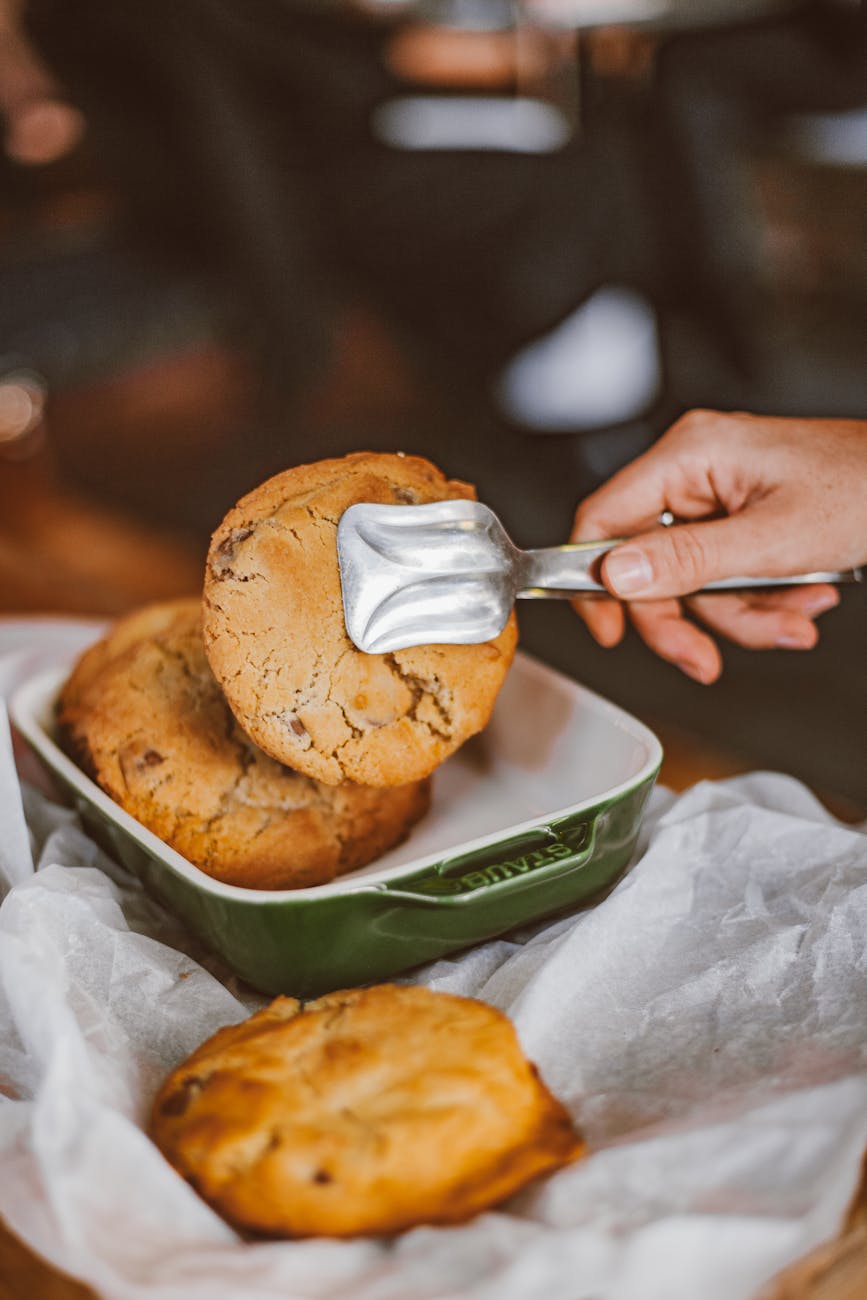
As the dough heats, fats like butter and shortening begin to melt, spreading the dough into its cookie shape. This change in state doesn’t alter the taste but is essential for shaping the cookie. Heating also causes sucrose to break down into glucose and fructose. As the temperature rises further, the proteins in eggs denature, changing their structure in an irreversible chemical reaction that adds firmness to the cookie’s structure.
As water evaporates, the dough begins to dry out—a physical change that contributes to the cookie’s final texture.
Around 310°F, the Maillard reaction occurs, as proteins and sugars break down and rearrange into ring-shaped molecules. These ring molecules reflect light, creating the cookie’s brown color while adding nutty, caramel-like, and toasty flavors and aromas. Just 40°F higher, caramelization begins as the remaining sugars break down, turning into hardened caramel. This process intensifies the cookie’s color and flavor even more.
Next Steps
Once out of the oven, cooling completes the process as sugar molecules recrystallize, affecting the texture and “snap” of the cookies, especially if the recipe is high in sugar. This crystalline structure is a physical change. Cooled cookies are sensitive to their environment: in dry air, they release moisture and harden, while in humid conditions, they absorb water vapor and soften. After cooling, they can be stored in a container to retain freshness—or enjoyed right away! Eating and digestion are part of a new series of chemical changes, but those are reactions for another day!
 The Official Blog of Edvotek®