


The model organism Caenorhabditis elegans (C. elegans) are trailblazers. These tiny, transparent roundworms have played an outsized role in our study and understanding of life. Here are five scientific firsts that make these worms legendary:
1. First multicellular organism to have its genome sequenced.
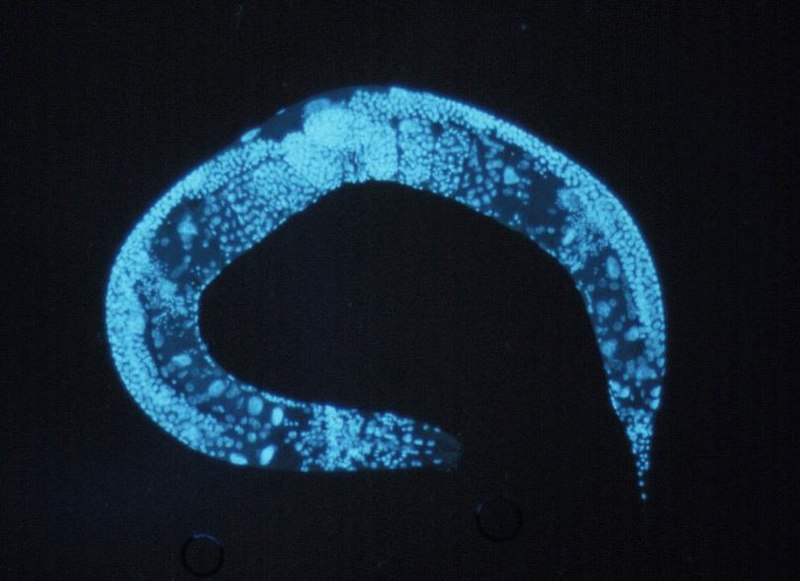
The sequencing of the C. elegans genome in 1998 was a groundbreaking achievement in genomics. At 97 mega base pairs (Mbp), its genome was huge compared to previously sequences single-celled organisms —Haemophilus influenzae (1.8 Mbp, 1995), Mycoplasma genitalium (0.58 Mbp, 1995), and Saccharomyces cerevisiae (12 Mbp, 1996). The C. elegans genome took nearly a decade to complete and involved a massive international collaboration (see blue box below). However, its success proved that whole-genome sequencing for complex organisms was feasible which paved the way for the Human Genome Project. Today, the C. elegans genome is used to study a range of topics including development, neurobiology, and the genetic basis of diseases. For example the first genes related to aging were discovered in C. elegans!
Next-generation sequencing and computer advancements have transformed whole-genome sequencing into a fast and widely accessible process. But in the 1990s, these tools didn’t exist. Instead sequencers could only handle stretches of 500–1,000 bp, which then had to be pieced together. To decipher C. elegans’ 100,300,000 bp genome, scientists developed a method that began with fragmenting the genome into 1,500 bp pieces and cloning these fragments into BAC (bacterial artificial chromosome) vectors. Each BAC fragment was then broken down into smaller segments called subclones, which could be sequenced. Researchers then reassembled the sequenced subclones back into their original BAC fragments and stitched (plus mapped) the BACs together to form a complete genome. It was a complex, laborious, fascinating, and field defining project.
2. First organism to have its connectome (a comprehensive diagram of neural connections) mapped.
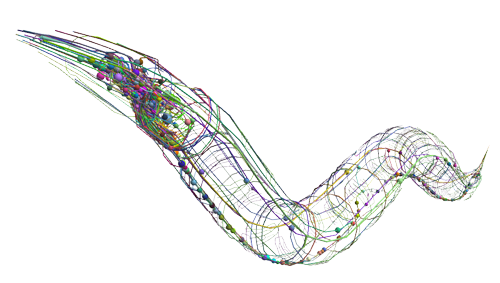
Nucleotides aren’t the only thing scientists have fully mapped in C. elegans. Back in the 1970s, Dr. Sydney Brenner and his colleagues set out to chart every one of the worm’s 302 neurons and the thousands of synapses connecting them. They discovered over 7,000 connections and publishing their work in 1986. In 2019, Dr. Scott Emmons and his collaborators used new technologies to map and publish a refined version. Researchers use the C. elegans connectome to better understand cognitive processes and neurological diseases. Today full connectomes also exist for the fruit fly (Drosophila melanogaster) and the sea squirt Ciona intestinalis. As for humans? There are ambitious efforts to map many of our neural pathways through the International Brain Initiative and NIH’s Connectome Programs.
3. First organism to have its complete cell lineage mapped.

What does it mean to have a complete cell lineage? It means that researchers have traced the developmental history of every single one of iC. elegans’ cells from egg to adult. This feat was possible because of C. elegans’ transparent body and small size (959 cells in an adult hermaphrodite, 1,031 in an adult male). Even more important is the fact that the species has a fixed number of somatic cells at maturity. Only a few organisms exhibit this trait, known as eutely. C. Elegans’ eutely means that every cell in every individual develops in the exact same way. Because this trait is so rare, C. elegans remains the only organism with a fully mapped cell lineage. The C. elegans lineage has, and continues to, help researchers understand development, genetic regulation, and apoptosis (programmed cell death). The lineage’s creators – Dr. Sydney Brenner, Dr. Robert Horvitz, and Dr. John Sulston – earned the Nobel Prize in Physiology or Medicine in 2002 for their work and the resulting discoveries concerning organ development and apoptosis.
4. First multicellular organism to have GFP inserted into it.

Green fluorescent protein (GFP) is one of the earliest and most widely used reporter molecules in molecular biology. In 1988, Dr. Martin Chalfie heard about GFP and immediately saw its potential in C. elegans. At the time, several labs were exploring whether the protein could be genetically introduced into a different species. A mix-up in addresses meant Chalfie’s lab received the gene later than others, but they still became the first to successfully express GFP in a new organism—first in E. coli, and two years later in C. elegans. In 2008 Dr. Chalfie was awarded the Nobel Prize in Chemistry, alongside Osamu Shimomura (who first isolated GFP) and Roger Tsien (who developed related fluorescent proteins). Today, GFP in C. elegans is still used to study everything from cellular development to to gene expression.
“One of the great things about working on C. elegans was the fact that it was transparent, and so when I first heard that seminar describing GFP, I realized, ‘I work on this transparent animal, this is going to be terrific! I’ll be able to see the cells within the living animal.’” – Dr. Martin Chalfie
5. First model organism used to study RNA interference (RNAi) and micro RNA.

C. elegans have proven to be a powerful tool for studying epigenetics—how organisms are shaped and altered by changes in gene expression (rather than changes in DNA). In the late 1990s, Dr. Andrew Fire and Dr. Craig Mello discovered that introducing double-stranded RNA into C. elegans could silence specific genes. This discovery redefined our understanding of gene regulation and led to the development of a powerful genetic tool that could target and silence specific genes. The discovery of microRNAs also emerged from C. elegans. Dr. Gary Ruvkun and Dr. Victor Ambros discovered small, non-coding RNA molecules that didn’t code for proteins and that also seemed to be regulating gene expression in C. elegans. Further investigation showed that these ‘microRNAs’ bound to messenger RNAs (mRNAs) and prevented them from being translated into proteins. In recognition of these discovery, Dr. Fire & Dr. Mello and Dr. Ruvkun & Dr. Ambros were awarded the Nobel Prize in Physiology or Medicine in 2006 and in 2024. (If you haven’t been keeping track, that’s Nobel Prize numbers 3 and 4 for these tiny but incredible worms.)
Trailblazers in the Classroom
C. elegans aren’t just transforming lab research—they’re also shaking up science classrooms by making animal behavior labs easy, exciting, and totally doable. You might be thinking, “Animal behavior labs? More like a logistic nightmare labs. Live organisms need constant care, die before the experiment even starts, and let’s not get into the mess, smell, and plain ick. Sure, the students get exciting—making predictions, watching behaviors like tail flicks or movement toward food, and collecting real data. But let’s be real: who has the time or resources to babysit live animals in an already hectic classroom?”

That’s where C. elegans changes the game. These tiny worms are easy to culture, resilient, and low-maintenance. You can keep an entire strain (a lineage of genetically identical worms) on a petri dish smaller than your favorite coffee mug. They only need feeding (feeding equals adding 5-6 drops of bacteria water to the plate) every three days. A missed feeding or a sudden temperature spike? No problem.
To make a C. elegan petri plates for a class you’ll need to master chunking (moving a square of agar from one plate to another). However, this process – which is a lot like what you would get if you combined making jello jigglers with flipping pancakes – is quickly mastered and can be done by the students. Not to mention the bang for your buck is big. C. elegans aren’t just cutting-edge, they’re cool. Even if you forget that these little wigglers are unlocking insights into everything from aging to environmental toxicity, it’s hard not to be fascinated by their quick movements and (if you’re a numbers geek like us) rapidly generated data.
But don’t take my word for it. See it for yourself at our workshop during the Philly NSTA conference. FRIDAY • 9:20-10:20 AM • Room #103C.
Can’t make it? Check out our C. elegans worm maintenance guide (more guides can be found on our blog), our video care & feeding guide, and our collection of C. elegans classroom experiments.

 The Official Blog of Edvotek®
4 comments
Comments are closed.