
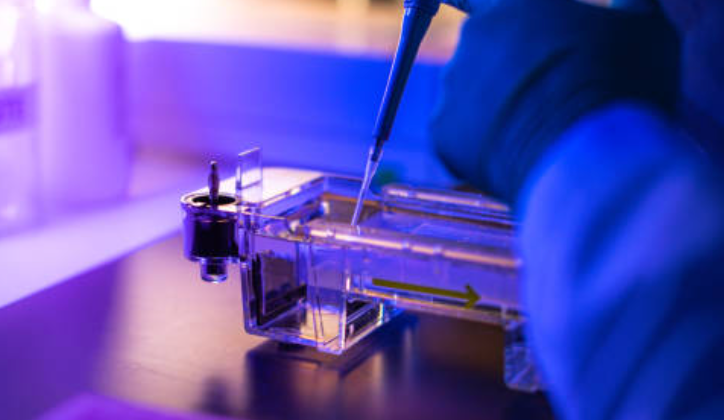

Electrophoresis uses an electric field to sort charged molecules through a gel matrix. Although both DNA and proteins can be separated this way, the methods are considerably different in gel type, sample prep, and visualization, all tailored to the unique nature of each molecule!
Gel Basics
DNA is typically run on agarose gels, which is a polysaccharide made from seaweed. These gels have microscopic pores and are poured in horizontal trays. Agarose gel electrophoresis is used for separating DNA fragments ranging from about 50 base pairs to several mega bases depending on the concentration of the gel. The base pairs travel through this porous gel matrix at varying speeds during electrophoresis, with smaller fragments moving faster than larger ones. This differential movement allows for the effective separation of DNA samples based on their size, which is useful in many ways including analyzing complex DNA mixtures, confirming the identity of genes, or size-checkingPCR products. By carefully manipulating factors such as gel concentration and voltage applied during the run, scientists can optimize the resolution of their results, making agarose gel electrophoresis a fundamental technique in biology.
Proteins, on the other hand, require, the use of polyacrylamide gels (PAGE). These gels have smaller, more refined pores and are set up in a vertical apparatus. Like DNA electrophoresis, protein electrophoresis also separates proteins based on size with proteins with heavier molecular weights traveling slower and remaining higher up on the gel than those with lower molecular weights. While there are several different types of polyacrylamide gels, one frequently used in our experiments is sodium dodecyl sulfate
Sample Preparation
With DNA, there’s no need for extensive prep to alter the charge. DNA is negatively charged due to its phosphate backbone and will inherently run towards the positive electrode in an electrophoresis chamber. This characteristic allows scientists to effectively separate different DNA fragments based on size as they migrate through the gel matrix.
Protein samples however, are trickier. They have a complex 3-D structure known as their folded form. The proteins must be denatured and coated in a detergent (such as sodium dodecyl sulfate (SDS)) to ensure the proteins are in a liner form and have a uniform negative charge. In SDS‑PAGE (sodium dodecyl sulfate–polyacrylamide gel electrophoresis), protein samples are treated with SDS and heated. This unfolds the proteins into linear chains. The SDS then binds to the porteins and gives them a negative charge. Sometimes, a reducing agent (like DTT or β‑mercaptoethanol) is included to further break down disulfide bonds and fully linearize the polypeptides. This process of denaturing the proteins allows them to be separated based on their molecular weight.
Materials Used
DNA electrophoresis most commonly uses TAE (tris-acetate-EDTA) or TBE (tris-borate-EDTA) buffers. These buffers are essential for maintaining a stable pH and adequate conductivity while running the gel. DNA electrophoresis also uses a horizontal electrophoresis chamber like our all in one integrated system the Edge! These gels are cast horizontally in various sizes of gel trays.
Protein electrophoresis primarily utilize glycine buffer. This is the most common buffer when running an SDS page gel. In some cases, other buffers can be used such as tris-acetate buffer for higher molecular weight proteins. Protein electrophoresis is also done in a vertical electrophoresis apparatus and the gels are loaded and cast vertically.
Visualizing the Results
To see the results, DNA is stained with dyes such as Sybr Safe. Sybr Safe is a nucleic acid stain that binds to the DNA molecular and fluoresces a bright green color when excited with blue light.
Protein gels on the other hand are most commonly stained with dyes. The most common protein stain is Coomassie Blue. Coomassie Blue binds to the proteins themselves staining them a dark blue color. The gel must then be destained in order to provide more contrast between the bands and the background.
Although DNA and protein electrophoresis share the fundamental principle, their approaches diverge in gel type, sample prep, and visualization. Agarose gels and straightforward staining make DNA electrophoresis clean and classroom-friendly. Protein electrophoresis calls for more complex gels, detergents, and stains, but opens the door to powerful tools like Western blotting. Both play a crucial role in biology, each customized to its target molecule!
 The Official Blog of Edvotek®