
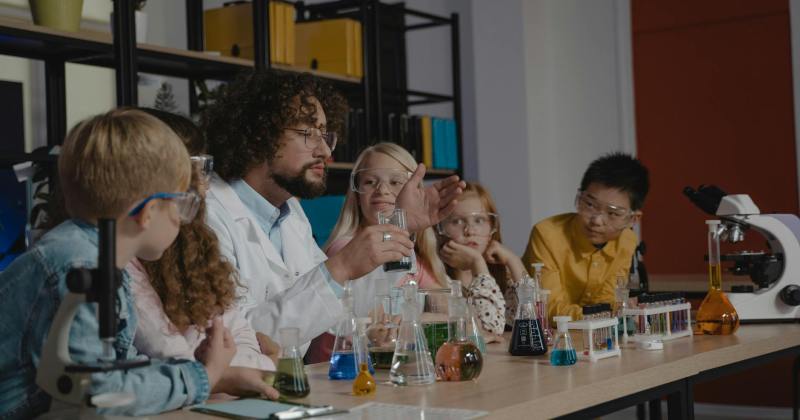

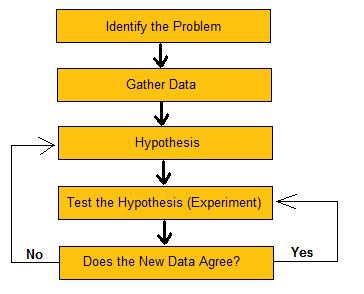
Today, let’s delve into the essence of the Scientific Method. It’s a topic likely on your teaching radar every year, and with every experiment, since our experiments are built around this framework. The Scientific Method serves as a structured roadmap guiding researchers in their quest to address inquiries within the laboratory. It begins with observation, followed by a thorough exploration of existing knowledge (Figure 1). Armed with this information, scientists formulate hypotheses—educated guesses that serve as the foundation for their experiments. As they proceed, they meticulously design and execute experiments, meticulously analyzing the resulting data before presenting their interpretations.
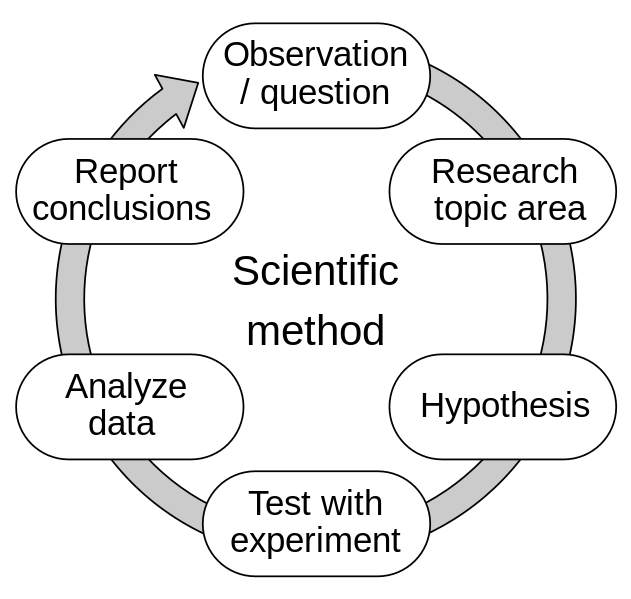
While it is traditionally depicted as a linear sequence (above), I find the Scientific Method more aptly represented as a circular process (Figure 2). Why? Because scientific discoveries don’t occur in isolation; they’re intricately connected to previous findings and observations. Each new revelation adds a piece to the puzzle, contributing to the ever-growing body of scientific knowledge that fuels subsequent experimentation.
Even so-called “negative” results play a crucial role in this iterative process. While they may not align with initial hypotheses, they offer invaluable insights, guiding scientists toward new avenues of exploration. In essence, every outcome—whether expected or not—propels us forward, building upon existing knowledge and informing future inquiries.
In the grand tapestry of scientific discovery, each step—each observation, hypothesis, experiment, and interpretation—adds depth and richness, weaving together a narrative of exploration and understanding. So, as we embark on our scientific journeys, let’s embrace the circular nature of inquiry, recognizing that every discovery, whether big or small, brings us one step closer to unlocking the mysteries of our universe.
Creating simple experiments with low stakes can be the perfect way to introduce your students to the scientific method. They can develop a hypothesis, create a protocol, test it, and iterate within a single class period. Then, they will be prepared to tackle more difficult problems when they arise during the semester. Here are some simple ideas to get you started.
- Surface Tension: Test surface tension by placing small droplets of water on different surfaces (e.g., wax paper, aluminum foil, plastic) and observing whether they bead up or spread out.
- Static Electricity: Rub a balloon against hair or fabric to create static electricity and observe how it attracts small lightweight objects like paper bits or cereal flakes.
- Paper Chromatography: Use markers to draw a line on a strip of filter paper, dip the bottom end into water, and observe the separation of colors as they travel up the paper.
- Floating Egg: Demonstrate density by adding salt to a glass of water until an egg floats. Remove the egg, add more salt, and observe how the egg sinks when the water becomes denser than the egg.
- Balloon Rocket: Thread a string through a straw, inflate a balloon and tape it to the straw, then release the balloon to create a simple rocket powered by air escaping the balloon.
- Cornstarch Slime: Mix cornstarch and water to create a non-Newtonian fluid that behaves like a solid when pressure is applied but flows like a liquid when left alone.
- Dissolving Candy: Drop different types of candy (such as M&M’s or Skittles) into water and observe how they dissolve at different rates due to varying sugar content and surface area.
Do you want to learn more about how to create simple experiments in your lab using equipment you might have, like our TruBlu 2? Check out our previous live stream here.
 The Official Blog of Edvotek®
1 comment
Comments are closed.