


As much as we would love to bask in the warm sunshine throughout the summer, occasional rainy days roll in forcing us to relocate indoors. While it may be a bummer to be stuck inside, there are still plenty of fun and educational science experiments you can do from materials you most likely have around your house already. For example, you could delve into the world of chemistry by mixing household ingredients to create colorful and fascinating reactions. The possibilities for scientific exploration within the comfort of your home are truly endless, and they can turn a dreary day into an exciting and enriching experience for all ages.
Science experiments don’t need to be long and complicated for them to be effective and insightful. In fact, simple experiments can often yield fascinating results and help in understanding fundamental scientific principles. By utilizing everyday materials and straightforward procedures, such experiments can be accessible to a wide range of individuals, including students, educators, and curious minds of all ages. Additionally, quick and straightforward experiments can ignite curiosity and enthusiasm for scientific exploration, paving the way for further inquiry and discovery in various fields. Check out the following experiments the next time the rain traps you inside or if you just want to escape the heat!
Experiment:
Molecular Gastronomy: Liquid Spherification
The Science: Spherification is a fascinating process that has revolutionized culinary techniques. This innovative method involves trapping liquid inside a gel-like membrane, creating unique and visually stunning culinary creations. Typically, spherification employs sodium alginate and calcium chloride. When these two substances interact, a remarkable reaction occurs, culminating in the formation of perfectly spherical, liquid-filled spheres. The soldium alginate is dissolved to seperate the sodium ions form the alginate molecules creating a liquid solution. This liquid is then added to the calcium chloride solution. The alginate molecules bind to the calcium ions forming calcium alginate. The calcium alginate molecules bind to each other forming a gelatin. This culinary technique not only showcases the intersection of science and gastronomy, but also opens up a world of creative possibilities for chefs and food enthusiasts alike. For a more home-friendly version of this, spherification can also be done with gelatin and oil!
Instructions:
- For this you will need two packets of gelatin, 2 cups cold vegetable oil, a 1/2 cup of liquid of your choosing
- Start by adding the vegetable oil to a tall glass and placing in the freezer (you need it very cold for the experiment to work
- Pour the 1/2 cup of liquid into a saucepan, add the two packets of gelatin, and heat until the solution is hot and all of the gelatin is dissolved. Once heated, let cool for five to ten minutes
- Remove the oil from the freezer and using a dropper or syringe drop the cooled gelatin mixture into the cold oil and watch as the spheres form
- Let sit for at least a minute and then strain out your spheres and rinse with cold water.
- You now have edible gelatin spheres that can be added to different foods such as ice cream or eaten on their own!
Bouncy Egg
The Science: While typically very fragile, eggs can become durable and bouncy just by a simple chemical reaction with vinegar. When an egg is left in vinegar, the acetic acid in the vinegar reacts with the calcium carbonate in the eggshell, producing carbon dioxide gas. This is evident by small bubbles that form on the eggshell. Over time, the carbon dioxide dissolves the shell, leaving the raw egg surrounded by a thin egg membrane. This membrane is squishy and surprisingly sturdy allowing for the egg to bounce from a height of a few centimeters.
Instructions:
- For this experiment you need a raw egg, a glass, vinegar, and gloves
- Gently place the egg in the glass and fill it with enough vinegar so that the egg is submerged
- Let sit for 48 hours and note any changes you see happening including any bubbles forming
- After two days, using a pair of gloves, gently remove the egg shell (it should rub off easily)
- With gloves still on, carefully drop your egg from a height few centimeters and watch it what happens! Note how different the egg looks, and feels than when you first started.
Color Changing Pasta
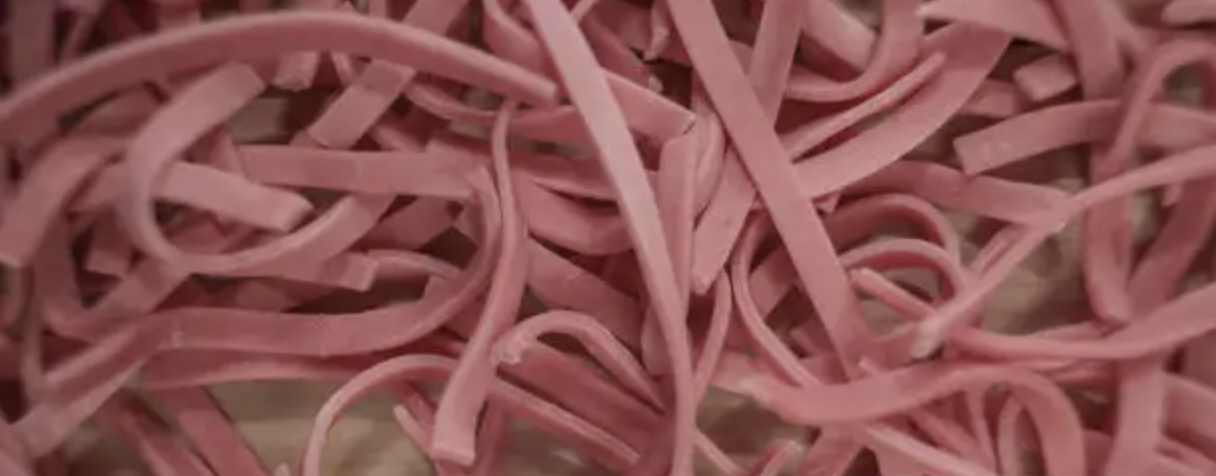
The Science: Red cabbage is a great example of a natural indicator as it contains a water soluble pigment that changes when it is introduced to an acid or base. The pigment present in red cabbage is called anthocyanin, and it is responsible for the color transformation. When the pH of the environment shifts, the anthocyanin in the cabbage leaf changes its structure, resulting in a visible alteration of color. This property makes red cabbage an excellent tool for educational purposes, as it can be used to visually demonstrate the concept of pH and how substances can be classified as acidic, neutral, or basic based on their interaction with the indicator. In more acidic environments the color of the pigment is bright pink, purple in neutral environments, and darker purple/blue in more basic environments. This natural pH indicator is a safer and more environmentally friendly alternative to synthetic dyes, making it a popular choice for scientific experiments and demonstrations in both educational and research settings.
Instructions:
- For this experiment you will need 1/2 a red cabbage, a package of rice noodles or vermicelli noodles (regular pasta will also work but the clearness of the rice noodles allows for a richer color), and a lemon
- Place the cabbage in a pot, cover with water, and bring to a boil
- Let boil until the water is a deep purple color (about 10-20 minutes)
- Carefully remove the cabbage (this can be discarded or saved and used for another recipe)
- Let the rice noodles soak in the hot water according to package instructions
- If using regular pasta boil the pasta in the cabbage water according to package instructions
- Remove noodles and place them in a clear bowl. Sprinkle with lemon juice and watch the noodles change to a bright pink color
There is an abundance of different fun activities to do indoors with reagents that can be commonly found in the kitchen. From simple science experiments to culinary adventures, the kitchen offers a plethora of opportunities for exploration and entertainment. These activities can also serve as excellent educational tools, teaching important scientific concepts and fostering a love for experimentation and learning. Additionally, they provide a great way to bond with family and friends while delving into the fascinating world of kitchen-based exploration.
For more activities, games, coloring pages, and earn badges check out our free activity book!
 The Official Blog of Edvotek®