

With the beginning of hockey season this week, have you ever considered the science behind the sport? From lightning-fast skating to powerful slapshots, there’s some pretty cool physics and chemistry behind the action on the ice. Here at Edvotek, in the heart of Washington, D.C., most people will be watching the Capitals play (note from author: I don’t blame you if you don’t like the Capitals)! However, this post is for anyone from any team! Learning about hockey science travels beyond the borders of team rivalries.
Skating: It’s All About Friction (or Lack of It!)
Ever wonder why hockey players can glide across the ice at super speeds? It all comes down to friction—or, more importantly, the lack of it. Friction is what slows you down when two surfaces rub together, like your shoes on the ground. On ice, there’s very little friction, so players can zoom around on their skates!
And the blades of hockey skates? They’re thin and sharp to cut through the ice, reducing friction even more. That’s how players can speed up, slow down, and turn on a dime.
Slapshots: The Force Is Strong with This One
Ever seen a player fire a puck across the ice at supersonic speed? That’s a slapshot in action! But what’s behind the power of that shot? Two big science ideas: force and momentum.
When a player swings their stick back and smacks the puck, they’re applying force. The harder the hit, the more force there is, and the faster the puck flies toward the goal. Add in some momentum from skating, and you’ve got a puck moving at speeds up to 100 miles per hour!
Goalie Superpowers: Reaction Time and Quick Reflexes
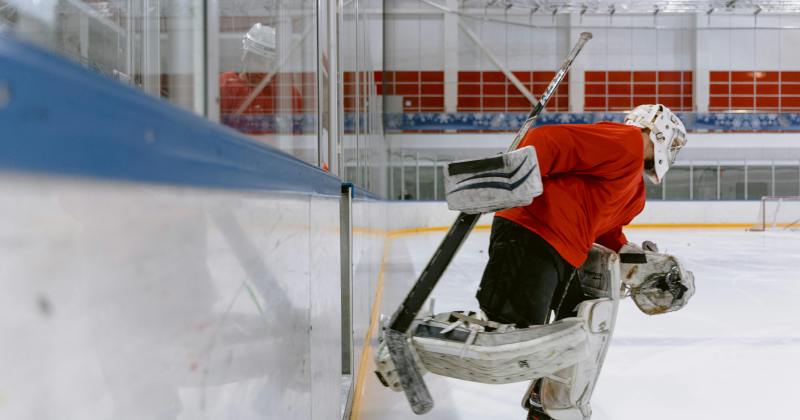
Goalies are the guardians of the ice rink, right? It’s like they have a sixth sense for blocking shots! But actually, they rely on something called reaction time. This is how fast they can see the puck, decide what to do, and then move to stop it.
It might look like magic, but it’s really the brain and muscles working together at lightning speed. Goalies have to block pucks traveling at crazy speeds, which means they have less than half a second to make the save. That’s mind-blowing! Or should we say goalie-glove blowing? In fact, goalies need to react to pucks flying at speeds of up to 100 mph in just 0.3 seconds—barely time to blink!
Puck Physics
Have you noticed that sometimes the puck spins through the air on its way to the goal? This spin isn’t just for show—it helps the puck stay on course and move smoothly, thanks to gyroscopic stability. The spinning motion helps stabilize the puck, making it more accurate and harder for the goalie to block.
Have you ever seen a player pass the puck off the boards or shoot it at an angle to get around an opponent? This isn’t just luck—it’s science! When the puck hits the boards, it bounces off at the same angle it hits. This is known as the law of reflection. Hockey players use this trick all the time to make clever passes or to set up tricky shots.
Hockey Is a Game of Science!
Hockey is more than just a sport—it’s an ice-cold lesson in physics! From the way players move to the way pucks fly and bounce, the game is full of science at every turn. So, next time you watch or play hockey, remember that you’re not just seeing fast action, you’re seeing science in motion!

