

Modern biotechnology has ushered in a new era of scientific discovery, with powerful techniques like genetic engineering and recombinant DNA technology transforming research and medicine. These innovations have enabled scientists to manipulate DNA sequences directly, significantly reducing the time needed to study and improve organisms. Among the most groundbreaking advancements in the past decade is the development of the CRISPR-Cas9 system—a precise, cost-effective, and efficient gene-editing tool that is revolutionizing the field of biotechnology.
If you want to try this experiment with your students, jump to the bottom of this article for downloadable resources or, better yet, join us at the upcoming NSTA National Conference on Science Education in Philadelphia! We will be offering this workshop and many more hands-on opportunities for you to try classroom-ready biotechnology
The Evolution of CRISPR Technology
The foundations of CRISPR (Clustered Regularly Interspaced Short Palindromic Repeats) were laid over 30 years ago when researchers first identified and characterized this system in bacteria. It wasn’t until the early 2010s that three research groups independently advanced CRISPR into a viable gene-editing tool:
- Jennifer Doudna at the University of California, Berkeley, and Emmanuelle Charpentier, then at the University of Vienna, worked on microbial CRISPR-Cas systems
- Feng Zhang at the Broad Institute of MIT pioneered the use of CRISPR in mammalian and human cells.
Their collective research demonstrated that CRISPR-Cas9 could be programmed to find and precisely cut specific DNA sequences, making it an invaluable tool for genetic modification. This discovery has since fueled remarkable progress in both basic research and clinical applications.
CRISPR as a Therapeutic for Hemoglobinopathies

One of the most promising applications of CRISPR technology is treating genetic disorders, particularly hemoglobinopathies—diseases that affect hemoglobin, the molecule responsible for transporting oxygen in red blood cells. Hemoglobin is a heterotetramer, a term that can be broken down for better understanding: Hetero means different, tetra means four, and in biology, a mer refers to a unit. So, a tetramer consists of four units, and a heterotetramer means those four units are different.
In adults, the two subunits are Alpha hemoglobin shown here in red, and Beta hemoglobin shown in blue. Each monomer has an iron-containing heme group, which is responsible for binding and transporting oxygen. In healthy cells, hemoglobin exists as free tetramers within the red blood cells.
Two major hemoglobinopathies, beta-thalassemia and sickle cell disease (SCD), result from mutations in the HbB subunit:
- Beta-thalassemia leads to insufficient HbB production, reducing hemoglobin levels and oxygen transport.
- Sickle cell disease alters HbB structure, causing red blood cells to deform and clump, leading to pain, anemia, and other complications.
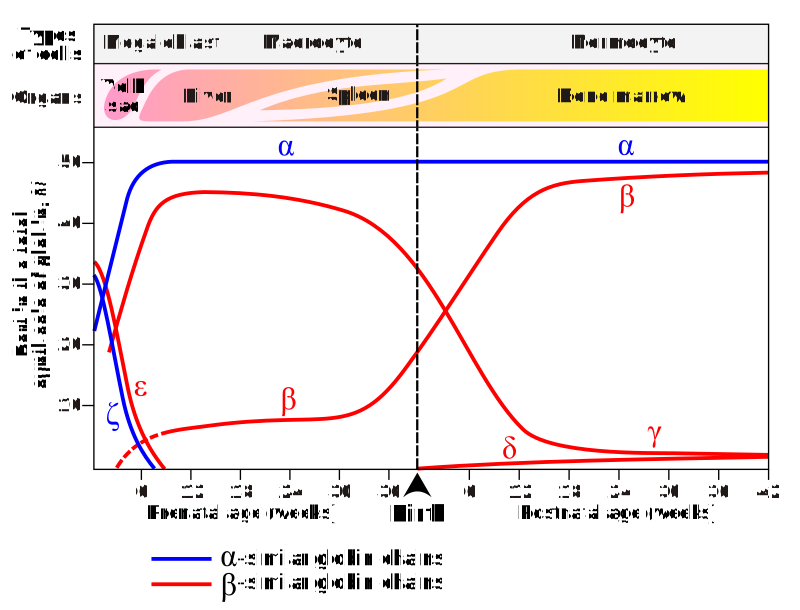
In actuality, humans produce different types of hemoglobin throughout life, including fetal hemoglobin (HbF), which is active during gestation but typically shuts off around age two as hemoglobin A (HbA) levels rise. However, researchers discovered that individuals with certain changes in the promoter sequence continue to produce HbF, resulting in milder symptoms of hemoglobin disorders. This is because HbF can compensate for defective hemoglobin B (HbB).
The production of HbF is regulated by the BCL11A gene, which normally suppresses its expression after infancy. This discovery led to the development of CRISPR-based therapies that inactivate BCL11A, reactivating HbF production. Clinical trials have shown that this approach significantly improves the quality of life for patients with beta thalassemia and sickle cell disease.
The Future of CRISPR in Medicine
The success of CRISPR in treating hemoglobinopathies is just the beginning. Researchers are exploring its applications for a wide range of genetic disorders, including cystic fibrosis, muscular dystrophy, and even certain cancers. As gene-editing technologies continue to advance, they hold the promise of transforming modern medicine, offering hope for previously untreatable conditions.
CRISPR has already changed the landscape of genetic research, and its impact on medicine will only continue to grow. This technology has now become a valuable part of our efforts to improve human health, make our food supply hardier and more resistant to disease, and advance any arm of science that involves living cells, such as biofuels and waste management. With further innovations and ethical considerations in place, this revolutionary tool could redefine the future of healthcare, making genetic diseases a thing of the past.
To download the slides: https://www.edvotek.com/site/pptx/2024_CRISPR_gene_editing_presentation.pptx
To download the literature: https://www.edvotek.com/site/pdf/2024_CRISPR_gene_editing_web.pdf
Resources for Bioethics: https://classroomscience.org/articles/fyi/introducing-your-students-bioethics-gene-editing-crispr
For more articles about CRISPR from Edvotek: https://blog.edvotek.com/?s=crispr
 The Official Blog of Edvotek®
3 comments
Comments are closed.