


Both CRISPR-Cas technology and restriction enzymes are key tools in molecular biology, particularly for editing and manipulating DNA. They act as molecular scissors that cut DNA at specific sites. This allows scientists to alter genetic material for various reasons, such as gene therapy, research, and biotechnology. Although they both assist in DNA editing, these tools work through different methods and provide varying levels of precision and flexibility. Lets go over the key differences.
Restriction enzymes are natural bacterial proteins discovered in the early 70’s. They cut DNA at certain recognition sequences that are usually 4-8 base pairs long. Each restriction enzyme targets a specific recognition sequence, which limits their range but provides predictable and repeatable results. These enzymes have been essential in genetic engineering since their discovery, leading to the creation of recombinant DNA technology and early gene cloning. There are over 3000 known restriction enzymes, each targeting a corresponding recognition sequence.
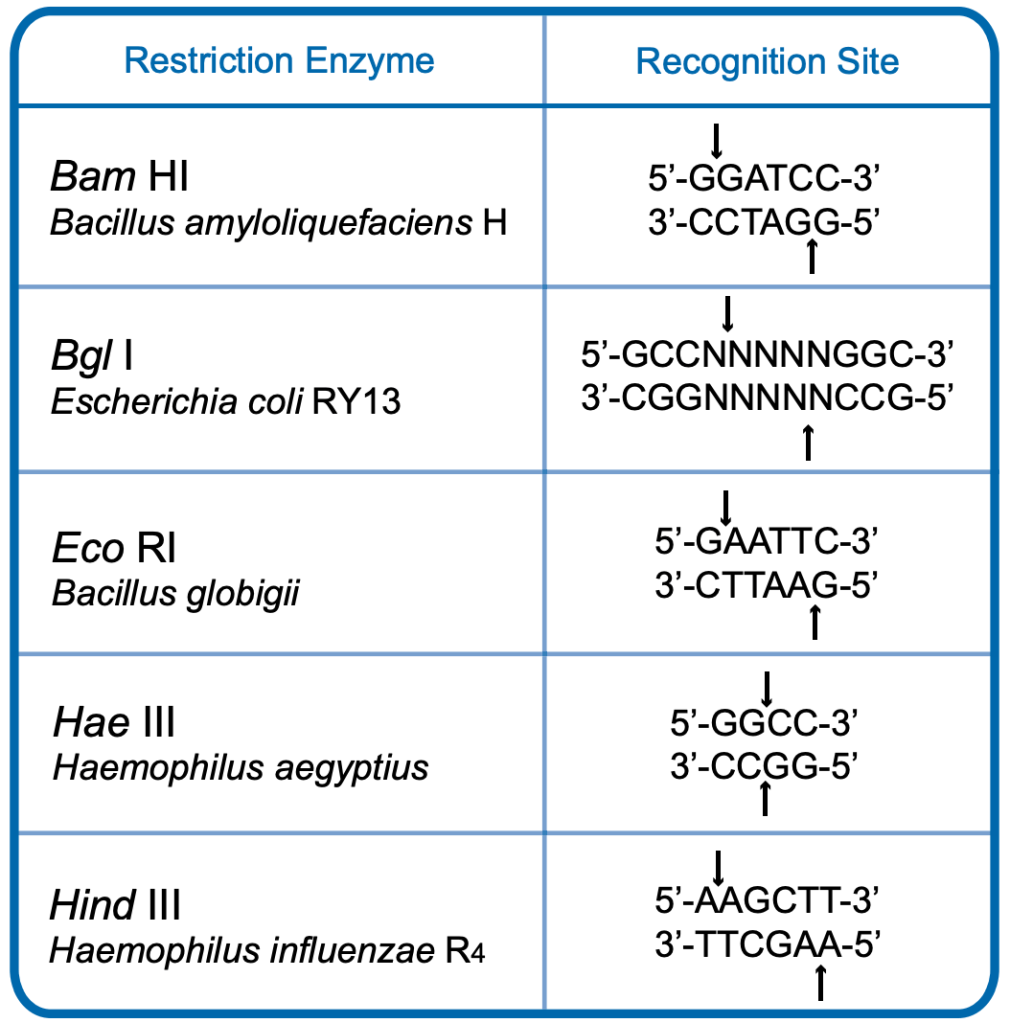
CRISPR-Cas systems are immune mechanisms bacteria use to protect against viruses. Discovered in the early 2010’s, CRISPR-Cas has become the most popular system for gene editing today. It uses a guide RNA (gRNA) to direct the Cas9 nuclease to a certain DNA sequence. Unlike restriction enzymes, CRISPR-Cas does not depend on fixed DNA motifs. Instead, it can be programmed to target nearly any sequence by changing the sequence of the guide RNA. This makes CRISPR-Cas much more flexible. Additionally, the guide RNA recognizes a longer stretch of DNA than the recognition sequence of restriction enzymes (approximately 20 nucleotides for gRNA compared to the 4-8 base pairs recognized by restriction enzymes). This allows CRISPR-Cas to make much more precise cleavages as well.

Despite their differences, both CRISPR and restriction enzymes perform the important function of introducing double-stranded breaks in DNA. The host cell’s repair system can then fix or modify the DNA. Both technologies come from bacterial immune systems and have been adapted for lab use, showing the importance of natural molecular tools in biotechnology.
In conclusion, while both restriction enzymes and CRISPR-Cas systems can cut DNA, CRISPR-Cas is notable for its versatility, efficiency, and ease of use when targeting specific DNA sequences. Restriction enzymes are still important for routine tasks in molecular biology, but they only can target a limited number of DNA sequences. CRISPR’s programmable nature has transformed gene editing by allowing targeted, complex, and scalable genetic changes with unmatched accuracy.
Interested in learning more? Check out our restriction enzyme and CRISPR kits below:


 The Official Blog of Edvotek®